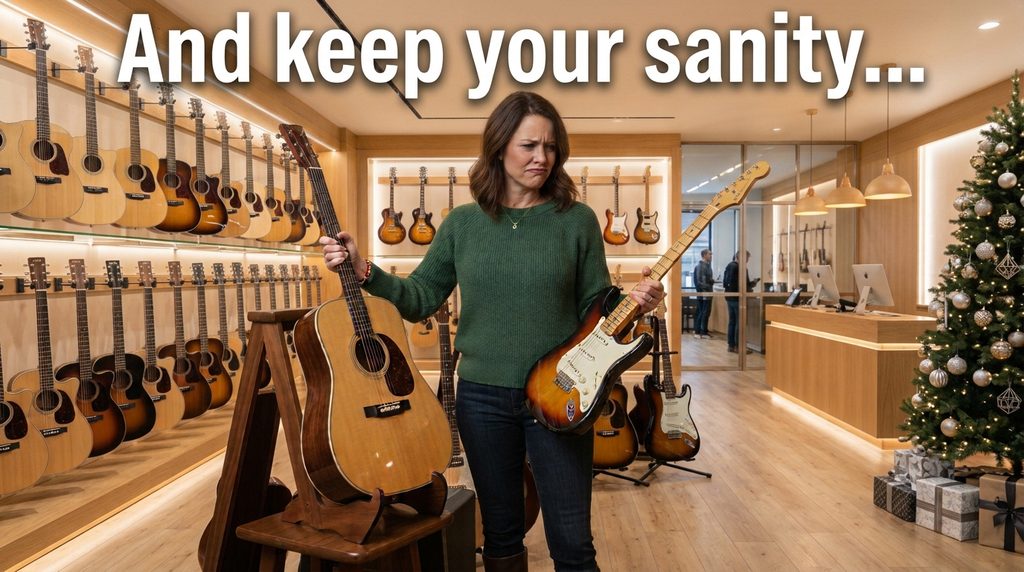
How do you choose?
Picking a guitar as a parent can feel so hard. My kids are very musical, and I’ve definitely been where you are now. You want to encourage them to explore. You want to help them find their passion. You’ve also probably also watched them discover things that AREN’T their passion and that can be expensive.
Buying your kid’s first guitar is part math, part psychology, and part crystal ball. You’re trying to pick an instrument that fits a small body, a modest budget, and a kid whose interests can change faster than a guitar string goes out of tune.
Here’s the most important thing I can tell you up front: you know your kid better than any reviewer, any salesperson, or any guitar teacher. A “best beginner guitar” list will narrow the field, but only you can answer the questions that actually decide the purchase. Let’s walk through them.
Start with your kid, not the guitar
Personality and staying power. Some kids latch onto something and stick with it for years. Others burn bright for six weeks and move on to the next thing. Neither is a flaw, but it should shape what you spend. If your child has a history of dropping hobbies, a sturdy, inexpensive guitar is a low-risk way to find out. If they have already shown they’ll practice without being nagged, a better instrument is easier to justify.
Responsibility and care for belongings. Be honest here. Does your child’s backpack, bike, and tablet survive the month? A guitar left on a bed, leaned against a wall, or tossed in a car trunk will take a beating. Wooden guitars are sensitive to dryness, humidity, heat, and bumps. If your kid is rough on things, durability needs outrank tone.
Travel and getting to lessons. Will the guitar ride in a minivan to weekly lessons, get lugged on a school bus, or live permanently in the living room? A guitar that gets carried around needs a decent bag or case and a body size that a small child can actually manage. Remember that a child hauling a bulky instrument plus a backpack is more likely to bang it into things.
Their size. This matters more than almost anything. A guitar that’s too big makes chords painful and discouraging, and many kids quit because of fit, not lack of interest. Height and arm length matter more than age. When in doubt, go slightly smaller, and try the guitar in person if you can. Your child should be able to hold it comfortably, reach the first few frets without straining, and press a string down without a struggle.
Think about the real cost
A first guitar can cost anywhere from under $100 to well over $1,000. Price doesn’t map neatly onto “better for a kid.” A few things to weigh:
- Fit beats finish. A well-set-up $200 guitar that fits will do more for a child than a $1,000 guitar that’s too big.
- Kids grow. A 1/2-size guitar may only last a year or two. Factor in resale value or hand-me-downs to a younger sibling.
- Budget for extras. A gig bag or case, a strap, a tuner, spare strings, and a professional setup (lower action makes a huge difference for small fingers) can add $50 to $100.
- Used and rental options. Many music shops rent instruments or sell used ones, which is a great way to test your child’s commitment before you buy new.
Prices below are approximate and were checked in November 2026. They change often, so verify before you buy.
The popular picks
Fender CD-60S (about $200–$230)
This is the default recommendation for good reason. It’s a solid-spruce-top dreadnought with a friendly neck, and it’s priced low enough that it won’t hurt if it gets dinged. One review calls its neck profile approachable for beginners and young players. The catch: it’s a full-size guitar, so it suits older kids (roughly 11–12 and up, or tall younger ones), not a six-year-old. Starter packs with a gig bag, strap, and picks are often available.
Taylor GS Mini (about $500–$700)
The GS Mini is one of the best-selling guitars on the market today. It’s size and flexibility also make it popular with adults. It has a short 23.5-inch scale length, which makes chords easier on small hands, and a body big enough to sound like a “real” guitar. Prices vary by model: sapele versions have been listed around $499, mahogany around $600, and the pickup-equipped “-e” versions around $700. It’s a very good fit for a child who has outgrown a 1/2 size or smaller guitar and shows real commitment. It’s also a guitar a kid can keep into adulthood. The trade-off is price, and a solid-wood top needs more careful handling than a laminate one.
Taylor 14ce (about $500–$600) and Taylor 114 (about $800-900)
The 14ce is Taylor’s entry-level Grand Auditorium with a cutaway: a solid torrefied spruce top, layered sapele back and sides, and Fishman GT2 electronics, usually listed around $599 (with a gig bag) and sometimes lower. The Taylor 114e, at roughly $800–$900, is the walnut-and-Sitka-spruce sibling with a 25.5-inch scale. Both sound great and feel like “real” Taylors, but they’re full-size, standard-scale guitars. That makes them best for teens, or for tall, committed kids. For a young child this is more guitar than they need, and more money than most parents should risk on a first instrument.
Gretsch Jim Dandy G9500 (roughly $190 and up)
This one is an underrated gem. It’s a throwback parlor guitar with a short 24-inch scale, a laminated body, and a lo-fi, vintage tone that players love. It’s small enough for many 9- to 12-year-olds, light, and inexpensive. It also looks great, which matters to kids more than parents expect. It has no built-in pickup, and the laminated build means it won’t have the polish of a Taylor, but it plays easily and costs little.
An Unconventional Pick: the Enya Nova Go
Here’s one most guitar lists skip. The Enya Nova Go is a carbon fiber travel guitar, about 35 inches long with a roughly 23-1/8-inch scale, so it’s effectively a 1/2-size instrument. The base model has been listed around $180, and the SP1 version with a built-in pickup, effects, and Bluetooth runs roughly $280 to $380.
Why consider it for a kid?
- It’s tough. Carbon fiber doesn’t care about humidity, and retailers describe it as heat-resistant and water-resistant. For a child who forgets the guitar in a hot car or leaves it near a heater or out in the cold, that’s a real advantage.
- It’s light and small, which makes it easy for a younger child to carry and hold.
- It’s travel-friendly, perfect for a kid who goes to lessons by bus, bike, or backpack.
- The SP1 version lets older kids plug into headphones or an amp for quiet practice and experimenting with effects.
The trade-off: it doesn’t sound like a wooden guitar. The tone is brighter and thinner, and some purists dislike that. But for a kid who’s rough on gear, travels a lot, or may lose interest, durability and portability can matter more than warmth.
A quick way to decide
- Younger child (about 5–8), uncertain commitment: a 1/2-size guitar or the Enya Nova Go is a sensible, low-risk start.
- Middle child (about 8–12), one that would practice regularly: a 3/4-size guitar, a short-scale pick like the Gretsch Jim Dandy, or the Taylor GS Mini if you want something that lasts.
- Tall tween or teen, committed: a full-size Fender CD-60S is the value choice, and a Taylor 14ce or 114 is the “reward” upgrade.
Final thoughts
There’s no perfect first guitar, only the right one for this particular kid at this particular moment. A guitar that fits comfortably, survives daily life, and doesn’t make you wince at the price tag gives your child the best chance of loving the instrument. Whatever you pick, get it set up properly, keep it somewhere visible so it gets played, and sit in on a lesson or two if you can. The best investment isn’t the guitar, it’s showing your kid that you’re excited about what they’re learning.
Want more help once the guitar arrives? Subscribe to the Playing Better Guitar channel on YouTube for lessons and tips, and visit PlayingBetterGuitar.com for more.
